Viglinks

Thursday, February 10, 2011

When will Muslim Pakistan Learn that Fomenting Terrorism Does not Pay

  I have been wondering that 2010 was perhaps the worst year for Pakistan, as it was besieged by a series of terror attacks. Pakistan was a creation of the British who wanted to leave India a truncated state. They pampered MA Jinnah and carved out an Islamic state. However the state created in 1947, had no history behind it  and to survive they created a bogey of 'Hindu India' .As a follow up Pakistan, started fomenting acts of terrorism against India. General Zia ul Haq was the man who refined the terror angle against India.. But in 2010 the same terrorism has bedeviled the country itself. With rampant corruption and also floods, 2010 is in real terms an extremely bad year for Pakistan.
One of the reasons for this upsurge in terrorist activity is a reaction by the Taliban to the attacks by the USA with drones. The watch word is revenge. Thus the Taliban and its ally Al Qaeda have with great ferocity attacked civil and military targets. The result is that over 2000 people were killed and thousands injured in 52 suicide attacks during the last year. Starting with the terror attack at Lakki Marwat which killed 90, there was no let up and attack after attack took place, that included an audacious attack on a mosque in Rawalpindi.

Many other shrines were also attacked and among them were the Datta Durbar shrine in Lahore and the Abdullah Shah Ghazi shrine in Karachi. In addition a terrorist attack on the Ahmadiyya sect killed over a hundred people of that community. Along with terrorism a politicized army and the Army chief dictating government policy is a matter of concern. Thus the Pakistan government cannot oppose the army which want India to be classified as enemy no 1, even if the Taliban and Al Qaeda run amok in the rest of Pakistan.

All this points to a heady cocktail of death and destruction with the army still feeling despite all the mayhem that ‘Hindu India’ is the greater threat.   Only deterrent action by India can nip this menace.

Monday, February 7, 2011

Who is the Greatest Hindu Warrior From History

Swords

This is a question that is difficult to answer as depending upon perception one can opt for any warrior from Porus who stopped Alexander to Hari Singh Nalwa who brought havoc on the Afghans in the North West. Then we have Shivaji Maharaja who battled the Moguls and Guru Gobind and Banda Abrader who also fought the Moslem tirelessly. But among all these warriors my vote will go to Samrat Hemchandra Vikramaditya, popularly called Hemu.


I vote for Hemu because of the peculiarity of his reign and the period he lived in. It should not be forgotten that Hemu lived at a time when the Hindus were bested in all battles by the Moslems. In such a scenario he was like the phoenix that rose from the ashes and fought the Moslems. It is in record that Hemu won 22 battles against the Moslems on the trot. No Indian king ever had won so many battles against the Moslems. He was also the first Hindu who after 350 years was crowned as Emperor at the Purana Quila. A painting of that period shows that even Afghan and Moslem chiefs paid homage to Hemu. In fact his fame spread far and wide and Historians have recorded that the Moslems had the element of fear when they faced Hemu.At the battle of Chhapparghatta in December 1555, Hemu routed the Bengal forces under Muhammad Shah, who was killed in the battle

Hemu was thus a great warrior. Let us now come to the second battle of Panipat which he fought against Akbar and his General Bairam Khan. Much has been written about this battle, but perhaps Hemu would have won if an act of providence had not come on the side of the Moslem army. Hemu suffered an arrow hit in his eye .This was just by chance and he was rendered unconscious. And the Moguls could rally and turn the tables on Hemu. I sometimes wonder whether it was the wish of the divine that the Moslem should rule over Hindustan. I can see no explanation for the defeat of Hemu except that it was fated for Moslem rule to be established in India.

But now after a lapse of 500 years we can look back at Hemu and admire him as the greatest of the Hindu warriors.

Sunday, February 6, 2011

The Hand and the Horoscope * 78


Recently I read a book 'Numerology by the eminent Astro Palmist Katkar. I was thrilled to read that the writer while in Bombay in the late forties of the last century was staying in a hotel.There he was approached two men who wanted to see his palm.This the astro numerologist readily consented. The men began to write some numbers on a piece of paper, keeping the hand in focus.

Katkar records that in about 15 minutes the men drew his  horoscope from the palm.It was an astounding feat says katkar to see the men casting an horoscope from the palm.This shows that the palm has a lot of mystery and is connected to the Astrological sciences.

The study of the palm and forecasts from it are in the realm of Palmistry. This is an ancient science, but to cast an horoscope from the hand shows that the hand and its lines have a deeper meaning.  Generally the left hand is associated with God given qualities and the right shows the actul developments. But it is a vast science and needs a lot of study.  I myself have studied this science for over 3 decades and can vouchsafe that one can make uncanny predictions from the lines on the Palm.

Saturday, February 5, 2011

Samrat Hemchandra Vikramaditya( Hemu)-Napoleon of India


 A lot many people haven't heard of Samrat Hemchandra Vikramditya popularly called Hemu. However for Hindus he is a beacon, the man who shook the Moslems and was the last crowned King of North India at Delhi.


The Second battle of Panipat

This battle in 1556 is in effect the the last stand of the Hindus against the Moslems. It was fought between s between Akbar the Mughul ruler and Samrat Hemu, the Hindu King at Delhi.

The Hindu General Hemu had won a succession of victories against the Muslims and he entered Delhi and had himself crowned as King in the Purana Quila –the fort built by Sher Shah Suri. It was the first time a Hindu ruler had worn a crown at Delhi in 350 years. This was a poignant moment in Indian history as Hemu ascended the throne in the Purana Quila. Prior to this the great Hemu had shown his prowess on the battlefield and had won 22 successive victories against the Moslems. This is unprecedented in Military History and for the first time the Moslems were scared to face Hemu. This it places Hemu on the pedestal of the great warriors among the Hindus.

Conduct of the Battle


Hemu straight away went on the offensive. Repeated charges by the elephant corps of Hemu soon had the Mughul army in disarray. Despondency set in and the Mughul were thinking of breaking battle and retreating.

Hemu proved he was an able commander as he directed the battle from the vantage point of his elephant skillfully. There is no doubt that Hemu was heading for victory. But then providence took a hand and a stray arrow hit the eye of Hemu and he was rendered unconscious. This had a deleterious effect on his army as the army seeing their commander incapacitated lost heart and frittered away their advantage.

Last Word

The Mughul thus converted a lost battle into victory. After the battle a semi conscious Hemu was brought before Akbar who beheaded him. Some historians claim that Akbar himself did not behead Hemu, but that is inconsequential as he was present there at that time. Akbar and the Mughus thus re-entered Delhi, but the exploits of Hemu earlier on proved that the Hindus were as brave as anybody. Let us salute Hemu !

Monday, January 31, 2011

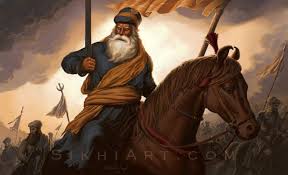
A Word About Baba Deep Singh

Recently I met some Sikh children and was surprised that no a child among them had ever heard of Baba Deep Singh. Not many know that BabaDeep Singh is one of the most revered names in Sikh history. As a martyr for the Sikh cause his name is bracketed at the top as the greatest of the great. Deep Singh’s claim to fame rests on the fact that he expelled the Moslems from the Golden Temple after the Afghan warrior Ahmed Shah Abdali had the temple razed to the ground and the sacred pool filled with dead carcasses of slaughtered cows.


Deep Singh and the Battle of Gohalwar

This episode jolted Deep Singh who then was 75 years old and busy translating the Sikh scriptures. He decided that the time had come to throw the Moslems out of the Golden Temple and restore its sacredness. He collected a small body of Sikhs and marched to meet the Moslems. As he moved forward a large number of Sikh peasantry joined him. This is one of the great romances of history. As Deep Singh advanced his force grew and to the cries of Sat Sri Akal, the Sikh Army moved forward.

Baba Deep promised the Sikhs that he would cleanse the temple and even if his head fell he would still continue fighting. Accordingly, the Sikhs met the Moslems in the battle at the village of Gohalwar on November 11, 1757. The Sikhs won the battle and the Moslem force was routed.


The Legend

Baba Deep Singh led the battle with great bravery but legend tells us that the head of Baba Deep Singh was decapitated. But he continued fighting by carrying his head in one hand and his Khanda (sword) in the other hand. Whatever the truth, the temple was freed and then rebuilt later. The spot where his head fell is a sacred spot in the temple premises. His Khanda which weighed 30 kg is still available as an exhibit at Takht Sri Hazur Sahib close to Nanded in Maharashtra.

The significance of Baba Deep Singh lies in the fact that he roused the Sikhs against the Moslems and defeated them. He is a man who is deeply respected among Sikhs as an outstanding martyr and it is about time that the younger generation learned about him.

Sunday, January 30, 2011

Sex, Japanese and Car Nicobar Tribals

Recently while going through some old notes of mine, I came across some jottings I had made while I made my visits to Car Nicobar island  nearly two and half decades back. These make interesting reading and one can realize that perhaps Subhas Bose was very naive man who could not distinguish between bad and good and bad and evil.


 The Car Nicobar Island houses a Air Force base and my purpose was basically to evaluate the Security  aspects of this base. The Island itself is beautiful  with lovely beaches. It has a perimeter road about 50 km in length, that circumference the island. I have driven on this road. During my visits and interacting with the head man a startling fact emerged.

The Japanese occupied the island in 1942, but they did not hand over the administration to the Indian nationalists. They continued to pay lip service to the cause of Indian independence and fooled Subhas Bose, who turned out to be naïve or plainly stupid.

As per the accounts related to me the soldiers of the Imperial army greatly desired the local tribal girls who were good looking. They wished to incorporate the young girls as comfort women for their troops with the more beautiful ones being reserved for the officers. This was resisted by the locals. The Japanese then did the unthinkable and started a massacre of the male population. In particular they targeted the educated elite who spoke English and just either beheaded them or shot them.

The Japanese followed up by claiming the women for their pleasure and after repeated rapes and sex, hundreds were impregnated. The Japanese gloated on their power over the women as they repeatedly raped and impregnated them. The head man shuddered at the thought and I also felt revulsion of the Japanese.They, thus to an extant changed the race of the Island.

This aspect of the Japanese occupation of the Car Nicobar Island need further study. Historians have some how ignored this area which was occupied by the Japanese. The Japanese account of the occupation makes me sad, worse I fell sadder that Subhas Bose sided with the Japanese.That is an irony of History

Thursday, January 27, 2011

A Man to be Admired-The Great Sikh General Hari Singh Nalwa


 Recently one of my old colleagues from the US Army who had completed the staff course at Wellington with me visited Mumbai. He told me he was writing a book on Sikh Warfare. He also mentioned that he was looking into the campaigns of Hari Singh Nalwa. Who was Hari Singh Nalwa ? Sadly many of our young men have never heard of him, so I thought to do a bit of research and put his life in brief on my blog.

It is important to remember that the Sikh empire stretched over what is modern Pakistan, with Lahore as its capital. In a series of battles the Sikhs had pushed the Afghans beyond the Khyber Pass and areas like Peshawar which had long been part of the Afghan( Durrani) empire had been captured. One man who made this possible was the Commander in Chief of Ranjit Singh's Army- Hari Singh Nalwa (1791-1837).


Hari Singh Nalwa joined the Sikh Army at a young age and by his feats on the battle field rose to be the foremost Sikh General. One aspect of his campaigns needs to be understood, that in 2000 years of history of the sub-continent , Hari Singh was the only Hindu/ Sikh general who ventured west wards and won significant victories. Prior to this all the invaders had come from the east only.

Hari Singh won significant victories against the Afghans and was instrumental in capturing Multan, Peshawar, Jamrud and the Khyber pass. In fact he conquered the entire present day West Pakistan. The Pathans and the Afghans suffered a series of defeats against him. So great was his fear among the Afghan Moslems that Afghan mothers would put their children to sleep with the words Raghe hari Singh( Hari Singh is coming). He was certainly the bravest of the brave.


Hari Singh was fluent in a number of languages including Persian and British and German travellers who met him will vouchsafe that he was a great soldier. Hari Singh’s claim to greatness rests on his campaigns against the Afghan Moslems whom he defeated as never before. In fact a popular 19th century British newspaper, Tit-Bits, published this piece in its edition.”Some people might think that Napoleon was a great General. Some might name Marshall Hendenburgh, Lord Kitchener, General Karobzey or Duke of Wellington etc. And some going further might say Halaku Khan, Genghis Khan, Changez Khan, Richard or Allaudin etc. But let me tell you that in the North of India a General of the name of Hari Singh Nalwa of the Sikhs prevailed. Had he lived longer and had the sources and artillery of the British, he would have conquered most of Asia and Europe.

Let us salute this great warrior who died on the battle field at Jamrud in 1837. His death was kept a secret from the Afghans who retreated thinking that Hari Singh was still alive, so great was the fear he inspired. One cannot think of a better inspiration for the young men of today than Hari Singh Nalwa. By the way he got the surname Nalwa after he killed a tiger in combat single handed!